- The Product Model
- Posts
- The Product Model #283 - The Role Of Stream Teams In ZeroBlockers
The Product Model #283 - The Role Of Stream Teams In ZeroBlockers
This Week’s Updates: Visual Metaphors, AI As Amplifier, Usability Tests, Cost Of AI Prototypes, Good Ideas For Coding Agents and more...

Rory Madden
March 10, 2026

The Role Of Stream Teams In ZeroBlockers
Empowered, autonomous teams can design and build better products because they are closer to the customers and can get quicker feedback.
But it isn't often clear how to go about setting up teams to work like this, because it is a dramatic change from the traditional way of working.
In this week's article, I go into detail about scope, core responsibilities, team composition, ways of working, and potential risks. I'd love to hear your thoughts on this approach, so feel free to reply to this email with any ideas, thoughts, or feedback.
Is your company ready to adopt empowered autonomous teams? |
This Week’s Updates
Enabling the Team
The Role Of Stream Teams In ZeroBlockers by Rory Madden
Stream Teams are the driving force behind a scalable, high-performing product organization. By maintaining alignment with strategic objectives while executing autonomously, they create a continuous flow of value without bottlenecks.
Your Strategy Needs A Visual Metaphor by Martin J. Eppler, Andri Hinnen and Fabienne Bünzli
Many strategies fail not for lack of vision, but because employees don’t understand or aren’t sold on enacting them. Effective metaphors pass the “4 Fs” test: fitting, familiar yet fresh, and facilitating action. Finding a metaphor that fits these principles will help leaders institutionalize meaningful visuals.
Product Direction
AI Is Not A Strategy. It’s An Amplifier by Vandana (Vinni) Munjal
Treating AI as an amplifier, not a strategy, means using pilots to surface gaps in information architecture, governance, and ownership. So automation lands on a coherent system instead of accelerating existing chaos
The Art Of Saying ‘No’ by Luke Albest
Treating “no” as the core product skill means guarding teams from the complexity trap, involving engineering early, and using feasibility checks, a minimum delightful product, and analytics to cut bloat so roadmaps stay focused on the few features that actually create value.
Continuous Research
How A Few Usability Tests Changed Our Whole Product Roadmap | Dscout by Bex Jeanson (Sponsored Content)
Bex shares how advanced usability testing unexpectedly changed her company’s product roadmap for months (and years) to come.
Five Research Questions That Provide The Foundation For Good Design by Sharma Hendel & Brenda Weitzer
Shifting from “we think” to “we know” means running every product idea through five evidence questions about audience, real use cases, unmet needs, solution fit and team fit, so design decisions rest on validated assumptions instead of personas, vibes and competitor copycats.
Continuous Design
A New Navigation Paradigm by Francisco Nunes
AI does not eliminate navigation; it delegates it to invisible systems, creating cognitive debt and hidden power, so designers need to treat interfaces as structures of thought and deliberately decide what to reveal, hide, and automate to preserve human agency and navigational skill.
The Hidden Cost Of AI Prototypes That Are Made To Die by Allie Paschal
AI makes it trivial to spin up glossy prototypes, but treating them as disposable creates hidden drag when nothing can be extended, handed off, or reused, so teams need to choose tools and workflows that produce structured, portable UI when the goal is to evolve ideas into a real product rather than just win a thirty-minute review.
Continuous Development
Where Good Ideas Come From (For Coding Agents) by Sunil Pai
Applying Steven Johnson’s seven ways to coding agents shows that LLMs excel at adjacent possible diffs and scaffolding but only become reliably useful when engineers supply explicit constraints.
The Next Two Years Of Software Engineering by Addy Osmani
Frames the next two years through five scenarios on juniors, skills, roles, specialisation and education in an AI heavy industry, giving developers and leaders concrete moves to stay valuable as coding shifts from typing to supervising complex, agent driven systems.
Seen an interesting article online? Share it with us, and we might feature it in our next issue!
Click here to share an article

THE UNBLOCKERS
Awards For Cross-Functional Teams In EMEA

At UXDX EMEA 2026, we wanted to do something a bit different. We’re launching The Unblockers to recognise teams that can show a real chain from evidence to decision to impact. There are three categories:
Impact Award for evidence that led to real outcomes
Best Use of AI Award for AI that meaningfully changed how you work or what you built
The Unblocker Award for removing the barriers that help cross-functional teams move faster
If your team has done work worth sharing, start with the quick entry form here before 22 March, and we’ll send you the next step for the full submission.
UXDX USA 10% Discount: 10NEWSLETTERUSA26 | UXDX EMEA 10% Discount: 10NEWSLETTEREMEA26 |


FREE COMMUNITY EVENTS
IN-PERSON 18 Mar: Copenhagen 19 Mar: Lisbon 24 Mar: Belgrade 25 Mar: Boston 25 Mar: Austin 15 Apr: Oslo 29 Apr: London 🔔 Want a UXDX Community event in your city? or, alternatively, if your company wants to host an in-person event, please reply and let us know. | ONLINE |
UXDX 2026 Speaker Announcements

Two newly announced speakers for UXDX 2026 are tackling the hard part of AI: making it work inside real enterprise constraints, with real teams, and real accountability.
At UXDX EMEA 2026 in Berlin, Timo Ilola from Taxfix will share how they are becoming an AI native organisation by embedding AI across design, product, and engineering. He moves beyond the hype with practical examples of where AI genuinely accelerates workflows, how roles are evolving, and what changes when teams stop shipping incremental updates and start driving strategic impact.
Over at UXDX USA 2026 in New York, Anya Gerasimchuk from McKesson will take you inside a three-year AI transformation across oncology and multispecialty care, where the bar for trust, safety, and compliance is non-negotiable. She will share how her team explores where AI can genuinely improve clinician productivity and patient outcomes, while being clear about where it must be constrained, how they reduce administrative burden, and how strong UX guardrails help protect trust in high-risk healthcare environments.
Missed the announcements of other speakers? You can find the highlights of the speakers announced in February here.
Video Of The Week
Design isn’t dead, but the narrative might be
Most teams are not asking whether design matters. They are asking whether design is anything more than polish, screens, and speed inside a sprint machine. In this week’s video, Pamela Mead challenges the story many of us have helped normalise: design as the UI layer, the misunderstood hero, the function that “plays around” in tools. Her point is simple and uncomfortable. When we reduce design to artifacts, we make it easier for organisations to treat it as optional and easier to imagine it can be automated away.
She unpacks what needs to change if design is going to stay influential through the next cycle: making decision-making legible, reclaiming design as problem-solving grounded in human behaviour, and moving from hero narratives to value-centered collaboration across disciplines. She also brings AI into the frame without the drama, arguing it is not a winner-takes-all game; it is a test of how teams evolve their ways of working together. Watch the full session:
The Results of Last Week’s Poll
The question: Where do you see the biggest risk of “perfecting the wrong thing” in your org?
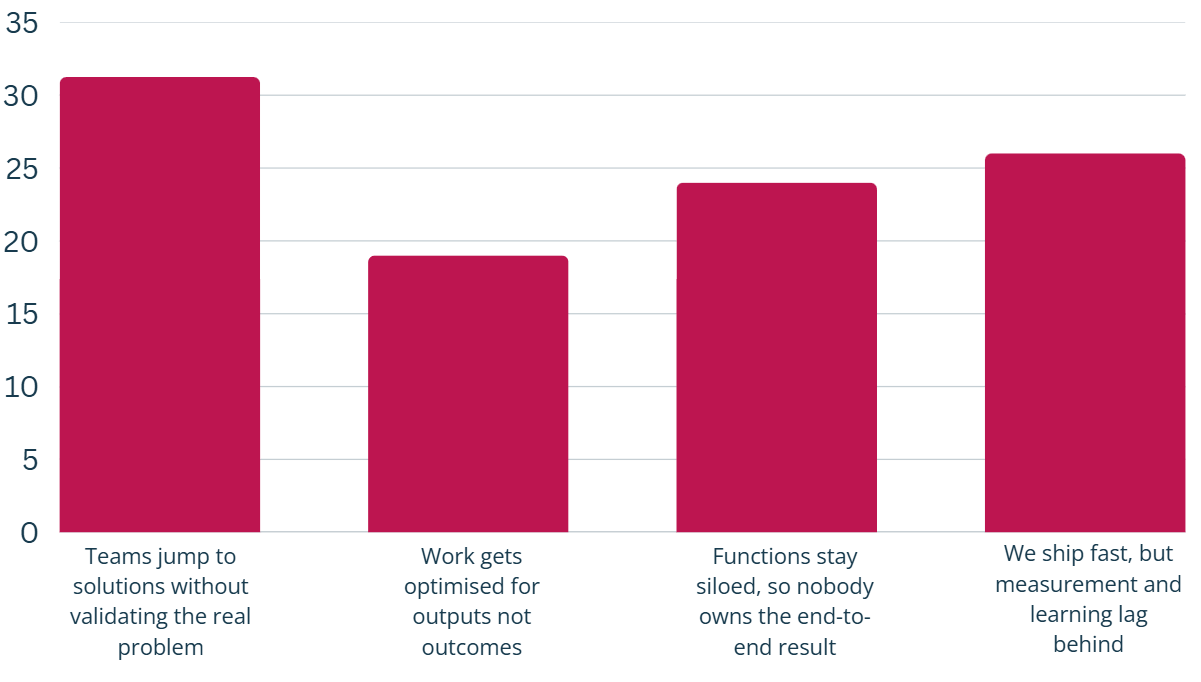
Last week’s poll asked where organisations are most at risk of “perfecting the wrong thing,” and the results show that the biggest problem still sits right at the start of the process. The top answer (31%) was teams jumping to solutions before the real problem is properly understood. Close behind, 26% said they ship quickly, but measurement and learning lag behind, while 24% pointed to siloed functions where nobody really owns the end-to-end result. Only 19% chose output optimisation, though I’d argue that’s often what sits underneath the rest.
What these answers have in common is a failure of feedback. Teams either start with weak problem framing, lose ownership as work moves through silos, or move so fast that learning arrives too late to shape the decision. That’s how organisations end up doing excellent work on the wrong thing: polished design, well-written PRDs, fast delivery, all aimed at a problem that wasn’t the highest-value one to solve in the first place.
The fix isn’t just “do more research” or “measure more stuff.” It’s building a stronger decision chain from evidence to problem framing to clear ownership to learning loops. Speed is useful, but only if it’s attached to judgment. Otherwise, you just get to the wrong answer faster.
If you want to go into how careers are shifting as AI compresses the ladder, my ebook Managing Your Career In The Age Of AI digs into the levels of thinking and how to keep building judgment in a world that keeps trying to automate it.