- The Product Model
- Posts
- The Product Model #284 - Truth Is Becoming Your Scarcest Resource
The Product Model #284 - Truth Is Becoming Your Scarcest Resource
This Week’s Updates: The Blame Game, Circular Metric Logic, AI Literacy, Design's Craft Crisis, Disposable Interfaces Due To AI and more...

Rory Madden
March 17, 2026

Truth Is Becoming Your Scarcest Resource
AI has made competent analysis cheap. What it cannot give you is the messy, human truth: what is actually happening, which assumptions are wrong, and what people are not saying out loud.
That gets harder as you grow. The more authority you have, the more feedback gets filtered by politeness, hierarchy, and self-interest. You lose the ability to think out loud because a half-formed idea can turn into someone else’s priority, or a quiet complaint you never hear.
The fix is not another dashboard. It is relationships and habits that keep you close to reality. Early on, you need people who show their reasoning so you can build judgement. Mid-career, you need cross-functional reality-checkers who will challenge your framing. Senior levels, you need a small circle of truth-tellers who are not impressed by your title and will tell you when you are about to make a mistake.
In an AI world, truth becomes a competitive advantage. Build the channels now, because by the time you realise you need them, the filtering has already set in.
How confident are you that you get unfiltered truth at work? |
This Week’s Updates
Enabling the Team
In an AI World, Truth Becomes Your Scarcest Resource by Rory Madden
The decisions that matter most depend on inputs that don't live in dashboards. The quality of your inputs has always mattered, but as people become increasingly reliant on AI to help with high-level decision-making, it is becoming more critical.
The Blame Game: How Bureaucracy Eats Responsibility by Joost Minnaar
When organisations optimise for blame, they add layers, rules and sign-offs that protect people from accountability while quietly killing initiative, so replacing guilt with learning, trust and shared ownership is what lets teams adapt and improve.
Product Direction
The Real-World Journey To Value And Product-Centricity by John Cutler
Moving from delivery centricity to product centricity is not a clean maturity curve, it is a messy shift where work, goals and value models overlap until teams, funding, org design and strategy gradually align around how the business actually creates value.
The Circular Logic Of Our Metrics by Pavel Samsonov
Chasing dashboard metrics as if they were strategy pushes teams to copy whatever is most salient and measurable, so real product thinking means reverse engineering the value behind the numbers and redefining success around what actually matters.
Continuous Research
Why The Distributed Growth Model Is Failing Research Teams—And What To Build Instead by Kate Towsey
Scaling research through distributed growth models spreads support thin and quietly degrades quality, so research teams need operating models built for resilience, clear service boundaries, and sustainable impact instead of growth era assumptions.
How AI Literacy Shapes GenAI Use by Maria Rosala
Using generative AI often doesn’t mean using it well. AI literacy requires both prompt fluency and the ability to assess outputs.
Continuous Design
Showing The Work Of Agents In UI by Luke Wroblewski
Designing UIs for agentic AI means neither hiding the process behind a spinner nor flooding people with every tool call; using progressive disclosure turns the agent’s step-by-step work into an optional progress layer and audit trail while keeping the main view focused on outcomes
Why AI Is Exposing Design’s Craft Crisis by Dolphia Arnstein
Regaining strategic influence means helping designers build enough technical fluency to judge feasibility, challenge constraints, and contribute meaningfully to product decisions.
Continuous Development
AI Makes Interfaces Disposable by Chris Loy
AI coding agents make it trivial for power users to spin up disposable interfaces on top of durable capabilities, so teams need to treat APIs and service layers as the real product and design them for openness, safety and extension instead of assuming everyone will always come through their official UI.
Use It Or Lose It by James Stanier
As managers offload more planning, reasoning, and synthesis to AI, they risk eroding the very cognitive skills their role depends on, so staying effective means keeping a minimum effective dose of coding, staying hands-on with new tools, and using AI to support judgment rather than replace it.
Seen an interesting article online? Share it with us, and we might feature it in our next issue!
Click here to share an article

THE UNBLOCKERS
Is Your Team’s Hard Work Getting Noticed?
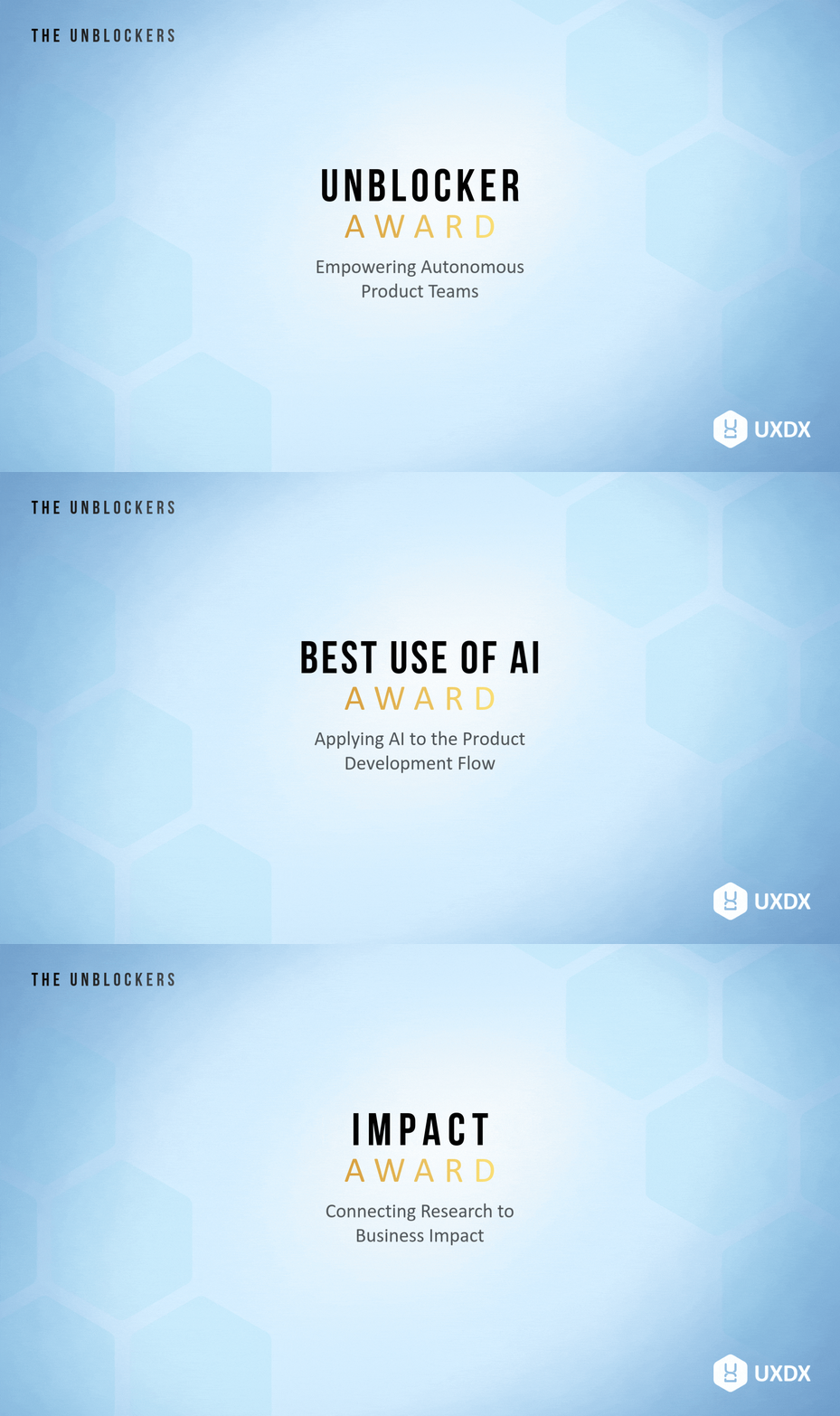
The deadline for The Unblockers Awards at UXDX EMEA 2026 is March 22nd.
Unlike other programs, we value impact over aesthetics. Whether you’ve mastered AI integration, cleared organizational hurdles, or driven massive retention, we want to see the "how" behind your "wow."
What’s in it for your team?
Validation: Direct feedback from our panel of expert judges.
Visibility: Promotion through post-event content and professional photos.
Value: Finalists can win team tickets to UXDX EMEA 2027 and a published case study.
It takes exactly 3 minutes to start the process. No long-form applications required right now. If your team has done work worth sharing, start with the quick entry form here, and we’ll send you the next step for the full submission.
UXDX USA 10% Discount: 10NEWSLETTERUSA26 | UXDX EMEA 10% Discount: 10NEWSLETTEREMEA26 |


FREE COMMUNITY EVENTS
IN-PERSON Tomorrow: Copenhagen (Sold out) 19 Mar: Lisbon 24 Mar: Belgrade 25 Mar: Austin 26 Mar: Madrid 15 Apr: Oslo 29 Apr: London 🔔 Want a UXDX Community event in your city? or, alternatively, if your company wants to host an in-person event, please reply and let us know. | ONLINE |
UXDX 2026 Speaker Announcements

If you are working through the realities of AI adoption, legacy systems, and organisational change, these are two sessions to keep firmly on your radar.
At UXDX EMEA 2026 in Berlin, David Sward from Siemens shares how his team tackled one of the toughest design system challenges at enterprise scale. He will unpack the journey from multiple specialised systems to a single design language across highly complex industrial products, and explain why Siemens chose to open source its design assets. Expect practical lessons on handling legacy products with decades-long lifecycles, designing for acquisitions, and building systems that can evolve without forcing one tech stack across the business.
At UXDX USA 2026 in New York, Andra Bond and Olivia Lucas, from Electronic Arts, will show how EA used its Experience Atlas and evolution mapping to move from product-centric planning to joined-up experience journeys across identity, loyalty and support. This session offers a practical look at how to align design, research, data science and operations, unblock delivery and create better customer outcomes through shared frameworks and measurement.
These sessions are essential for leaders trying to scale better ways of working across complex organisations, especially where transformation needs to lead to real outcomes rather than more process.
Missed the announcements of other speakers? You can find the highlights of the speakers announced in February here.
Video Of The Week
The Superpowers and Shadows of A/B Testing:
Balancing Data-Driven Success with Bold Innovation
A/B testing can feel like a cheat code. You get clarity, confidence, and a chart that makes the decision look obvious. Ryan Leffel (Head of Design) makes the case for why that same superpower can quietly trap teams in over-optimisation, risk avoidance, and a slow drift away from bold product thinking.
In this talk, Ryan shows how Priceline uses testing to de-risk change, not just chase bookings, then unpacks the four strengths of A/B testing and the shadow each one can cast: reactivity, tunnel vision, analysis paralysis, and runaway complexity. He also breaks down the biases that quietly distort decision-making, using Groupon’s email fatigue spiral as a warning, and shares how leaders can build a culture where curiosity beats certainty.
The sharpest takeaway is the “local maxima” trap: months of tiny tweaks that never unlock the bigger opportunity. Sometimes the real move is not another button test. It is the breakfast sandwich. Watch the full talk now:
The Results of Last Week’s Poll
The question: Is your company ready to adopt empowered autonomous teams?

Last week’s poll asked whether companies are ready to adopt empowered autonomous teams, and the answer is more sceptical than optimistic. Only 23% say they already work this way, with another 12% saying parts of the organisation are moving in that direction. The majority are still on the outside: 38% say they’re not ready, and 27% say they simply do not want to go there.
That split matters. A lot of organisations talk about empowerment as if it is an obvious next step, but the results suggest many still see it as either impractical or undesirable. In some cases, that is honest self-awareness. If the organisation lacks a clear strategy, fast feedback, or trust in teams, “autonomy” can quickly turn into drift. In other cases, though, the resistance is more about leaders not wanting to let go of control.
The real question is not whether autonomous teams sound good in theory. It is whether the surrounding system is designed to support them. Teams need clear outcomes, boundaries, and evidence loops. Without those, autonomy feels reckless. With them, it becomes one of the few ways to increase speed and ownership without increasing layers of management.
If you want to go into how careers are shifting as AI compresses the ladder, my ebook Managing Your Career In The Age Of AI digs into the levels of thinking and how to keep building judgment in a world that keeps trying to automate it.