- The Product Model
- Posts
- The Product Model #285 - All Jobs Have Four Layers. AI Wants Three of Them.
The Product Model #285 - All Jobs Have Four Layers. AI Wants Three of Them.
This Week’s Updates: The Best Leaders Follow, PM Vibe Coding, Structuring ResearchOps, AI Sped Up Execution, Replacing Developers Every Decade and more...

Rory Madden
March 24, 2026

All Jobs Have Four Layers. AI Wants Three of Them.
Most product jobs are really four layers of work.
Level 1 is task execution. Level 2 is choosing the right solution and trade-offs. Level 3 is deciding what problem is worth solving. Level 4 is setting direction under uncertainty.
AI is already compressing the bottom two layers. The timelines in this piece are opinionated, but the sequence is the point: as models get better at consistency and “remembering” your system, task execution gets automated first, then solution design starts to follow. That shifts the baseline from “can you produce” to “can you decide”.
Where humans keep leverage is higher up the stack. Problem framing is hard to automate in established organisations because the context and decision history often is not captured anywhere. Direction setting stays human because accountability cannot be delegated.
The practical takeaway is to move up a layer on purpose. Get fluent in trade-offs, then in systems thinking across functions, and start caring about the “why” behind decisions, not just the “what”. That is where careers and companies stay resilient as AI improves.
What is the biggest blocker to using AI for higher-level work in your organisation? |
This Week’s Updates
Enabling the Team
All Jobs Have Four Layers. AI Wants Three Of Them by Rory Madden
If you work in product development, as an engineer, designer, product manager, or researcher, you're watching AI reshape your profession in real time. The question isn't whether AI will change your work. It's when, how much, and what you should do about it.
The Best Leaders Are Great Followers by Tomas Chamorro-Premuzic and Amy C. Edmondson
The most effective leaders are those who exhibit the same attributes as exemplary followers. They excel at listening, learning, and adapting rather than commanding from the top. Leadership and followership are co-created, fluid roles, not heroic acts of command.
Product Direction
Is AI Disrupting Product Development? by Itamar Gilad
AI is changing how teams work, but not the fundamentals of product development, so the real advantage still comes from improving discovery, judgment and time to outcome rather than just shipping faster with new tools.
How PMs Can Vibe Code To Build Stronger Requirements by Chris Butler
Using vibe coding to explore rough ideas, generate variations, and pressure test assumptions helps PMs turn fuzzy thinking into clearer requirements, stronger trade-offs and better aligned product decisions before the wider team gets involved.
Continuous Research
GenAI for Complex Questions, Search for Critical Facts by Maria Rosala and Josh Brown
Users choose AI to explore and synthesize information, but they rely on traditional search when accuracy and trust are critical.
A Practical Guide To Structuring Researchops Through Organizational Change by Carolyn Morgan
Reorgs force ResearchOps teams to rethink structure, support and decision rights, so choosing between centralized, decentralized and hybrid models means balancing consistency, proximity and scale instead of chasing a perfect org chart.
Continuous Design
AI Sped Up Execution. Your Team’s Decision-Making Hasn’t Caught Up by Niyati Gupta
As AI makes execution cheap, judgment becomes the real constraint, so teams need explicit decision systems that surface dissent, clarify ownership and match deliberation to the stakes of the bet instead of mistaking fast prototyping for real progress.
Design Leaders Need To Jam With Their Teams by Jon Daiello
Treating design leadership as apprenticeship rather than distance management means pairing on hard problems, giving detailed craft feedback, and modelling how decisions get made, so junior designers grow through proximity instead of being left alone with frameworks and design systems.
Continuous Development
Who Does What And How To Support Them by Anton Zaides
Allocating work well means balancing company needs, individual growth and team resilience, then matching support to task-specific maturity rather than job title so stretch assignments build capability without creating fragile teams.
Why We've Tried To Replace Developers Every Decade by Stephan Schwab
Every wave from COBOL to AI promises to make developers optional, but the real bottleneck is not syntax or typing speed; it is the judgment needed to handle complexity, edge cases, and evolving systems well.
Seen an interesting article online? Share it with us, and we might feature it in our next issue!
Click here to share an article

Want To Make Your Case To Join UXDX 2026?
This is where you can start:

If you’re trying to make the case for UXDX 2026 internally, the 2025 Post Show Report is a useful place to start. It provides a clear picture of the types of talks, themes, and practical takeaways teams gained from last year’s event, making it much easier to show your manager the value in real terms.
A lot of people use it as a simple way to support approval conversations: what was covered, what problems were tackled, and why it matters for product, research, design, and engineering teams heading into 2026.
Download it here: https://uxdx.com/post-show-report/
UXDX USA 10% Discount: 10NEWSLETTERUSA26 | UXDX EMEA 10% Discount: 10NEWSLETTEREMEA26 |


FREE COMMUNITY EVENTS
IN-PERSON Today: Belgrade Tomorrow: Austin 26 Mar: Madrid 15 Apr: Oslo 16 Apr: Boise 29 Apr: London 🔔 Want a UXDX Community event in your city? or, alternatively, if your company wants to host an in-person event, please reply and let us know. | ONLINE |
UXDX 2026 Speaker Announcements

AI Readiness Starts Here! Ready to move beyond AI hype and tackle what real implementation looks like inside complex organisations? Here are some workshops you can look forward to at UXDX 2026:
Mirela Mus joins us at UXDX EMEA 2026 in Berlin with a hands-on workshop focused on how to future-proof careers, products, and business models in the age of AI. Through three real case studies, Mirela will show how to move from using LLMs to speed up workflows toward identifying and prioritising AI-first product opportunities that can create genuine value.
Llewyn Paine will lead a strategic workshop on Agent Experience (AX) testing at UXDX USA 2026 in New York. She will show how leaders can spot where websites, SaaS products, and apps break for AI agents, and what that reveals about commercial risk, operational readiness, and product strategy, helping teams understand their Agent Gap and what it takes to close it.
These workshops are ideal for leaders who want practical, grounded ways to respond to AI transformation, strengthen cross-functional decision-making, and build products that are ready for what comes next.
Missed the announcements of other speakers? You can find the highlights of the speakers announced in February here.
Video Of The Week
Data Science at The New York Times
Chris Wiggins (Chief Data Scientist at The New York Times) walks through what it takes to turn behavioural data into better product decisions, without losing the human intent behind the numbers. As the Times evolved from a newspaper into a bundle of digital experiences across apps, audio, cooking, games, Wirecutter, and Wordle, the real challenge became alignment: what are we optimising for, and what are we willing to trade off?
Chris breaks down the difference between prediction and prescription, why experiments come first, and how data science creates the most value when it helps teams decide what to do, not just report what happened. You will also hear practical examples, from tuning paywall friction with a real-time model and “knob meetings,” to building recommendation systems with editorial guardrails and self-serve tools that fit real workflows. Watch the full talk by clicking the banner below:
The Results of Last Week’s Poll
The question: How confident are you that you get the unfiltered truth at work?
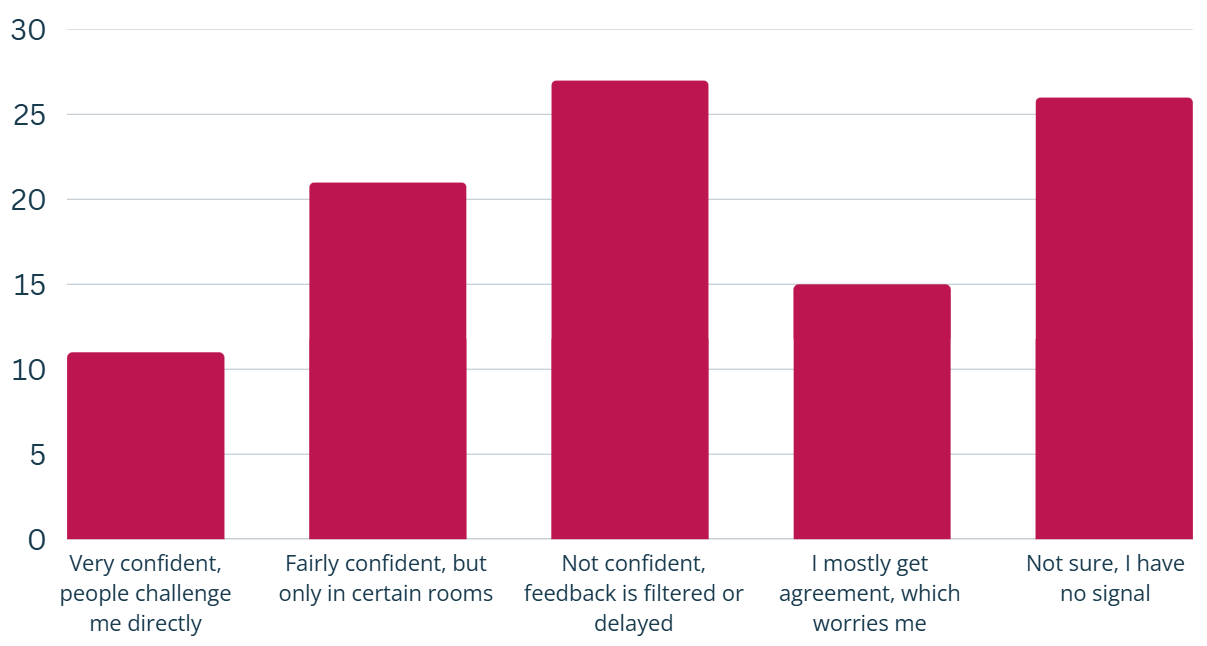
Last week’s poll asked how confident people are that they get the unfiltered truth at work, and the results are not exactly reassuring. Only 11% say they are very confident that people challenge them directly. Another 21% feel fairly confident, but only in certain rooms. That leaves the majority either not confident because feedback is filtered or delayed (27%), worried because they mostly get agreement (15%), or unsure because they have no real signal at all (26%).
That matters more than most teams realise. Once feedback starts getting softened, delayed, or selectively shared, decision quality drops fast. Leaders end up managing the version of reality that is safest to say out loud, not the most useful one. And when “everything sounds fine” becomes the default, you often find out the truth only after the costs have compounded.
Getting the unfiltered truth is not about asking people to be braver. It is about building systems where honesty is normal: direct access to users, exposure to raw evidence, regular challenge from peers, and enough trust that disagreement is seen as contribution, not disloyalty.
If you want to go deeper on how careers and leadership are shifting as AI compresses the ladder, my ebook Managing Your Career In The Age Of AI explores how to build judgment, relationships, and influence in a world that keeps trying to automate the surface of the work.