- The Product Model
- Posts
- The Product Model #287 - Analysing A Successful Product Vision
The Product Model #287 - Analysing A Successful Product Vision
This Week’s Updates: Beyond Waterfall, Coding Agents, Users' Unmet Needs, Vibe Prototyping, AI Adoption Journey and more...

Rory Madden
April 07, 2026

Analysing A Successful Product Vision
Most product visions end up as abstract statements that sound impressive but fail to inspire action or drive decision-making. To understand what makes a vision truly powerful, we analysed SpaceX's Mars mission video, which transforms the company from a transportation logistics provider into the architect of humanity's multi-planetary future.
The four-act story begins with people, not rockets, because a vision is about your users, not your product. It then builds credibility by demonstrating that they've thought through some of the more complex elements of a Mars flight, such as the reusability of the rockets and the solution to challenges like fuel capacity and a Mars landing.
By using proven storytelling principles, SpaceX has developed a product vision that aligns the teams internally, is a great recruitment tool and has attained a lot of free marketing. Check out my article below for a deeper dive.
Which SpaceX narrative technique would be hardest to replicate for other products? |
This Week’s Updates
Enabling the Team
Positive Vs Negative Freedom In Organizations by Joost Minnaar
Removing hierarchy creates structural freedom, but that alone does not make people self-directing, so organisations also need the relational conditions and human capabilities that help teams use autonomy well, rather than recreating dependence in new forms.
Beyond The Waterfall State: Why Missions Need A Different Decision-Making Architecture by Jack Strachan
Innovation efforts often fail not because of weak ideas, but because learning arrives after the key decisions have already been made. Dive into decision architecture, cross-functional sense-making, and how to structure missions, prototypes, and commitments so teams can adapt before direction gets locked in.
Product Direction
Analysing A Successful Product Vision: SpaceX by Rory Madden
The SpaceX-to-Mars video is a masterclass in narrative marketing. It positions SpaceX as the architect of our multi-planetary future rather than just a transportation company. Let's break down exactly how they do it and why it is so effective.
On Coding Agents And The Future Of Design by Jeff Veen
Coding agents could push products toward clearer, more atomic capabilities, making design more about strategy than screens. Go into AI-native product direction, interface abstraction, and what the product really exposes underneath.
Continuous Research
Harness The Power Of Users' Unmet Needs | Dscout (Sponsored Content) by Nikki Anderson
Taking actions like looking through existing data, mapping the customer journey, and identifying high cognitive load can set you on the right track.
AI Can Help With Survey Writing, But It Still Requires Human Expertise by Rachel Banawa
AI can produce polished survey drafts quickly, but experienced human review is still needed to catch subtle survey-design flaws that weaken data quality.
Continuous Design
When Design Stops Asking Why And Starts Asking “Can AI Do It?” by Dolphia
AI is flipping the order of product decisions, pushing teams to react to polished outputs before asking whether the work should exist at all.
Vibe Prototyping Is A Double-edged Sword by Ed Orozco
A strong caution against letting vibe-coded prototypes create false confidence. Useful in the difference between making something look real and actually testing whether the idea, flow, or business case holds up.
Continuous Development
My AI Adoption Journey by Mitchell Hashimoto
Mitchell's experience adopting any meaningful tool is that he has necessarily gone through three phases: (1) a period of inefficiency, (2) a period of adequacy, and finally (3) a period of workflow and life-altering discovery.
The AI Vampire by Steve Yegge
AI can raise output quickly, but without clear limits, the gains often show up as more pressure, longer hours, and faster burnout. Teams need to set healthier expectations around pace, workload, and who benefits from productivity gains before AI speed turns into extraction.
Seen an interesting article online? Share it with us, and we might feature it in our next issue!
Click here to share an article

Quick Entry Is Closing For The Unblockers!
Don’t miss your chance to shine at the awards in EMEA
Due to requests, we have extended the quick entry of ‘ The Unblockers’, our first ever EMEA Awards, to the 10th of April. Which means the final entries can go in this week for a shot to shine on the stage at UXDX EMEA 2026. There are three categories you can submit for:
Impact Award — evidence that led to real outcomes
Best Use of AI — AI that meaningfully changed how you work or what you built
The Unblocker Award — removing the barriers that help cross-functional teams move faster
If your team has done something worth sharing, the entry takes 3 minutes. Just a quick form and we'll send you the next steps afterwards. Finalists get team tickets to UXDX EMEA 2027, global exposure, and a published case study. The deadline is this Friday: https://airtable.com/appZDHX5d901bzueE/pagjVBIAq87H1G8rU/form
UXDX USA 10% Discount: 10NEWSLETTERUSA26 | UXDX EMEA 10% Discount: 10NEWSLETTEREMEA26 |


FREE COMMUNITY EVENTS
IN-PERSON 15 Apr: Oslo 15 Apr: Lisbon 16 Apr: Boise 17 Apr: Edinburgh 21 Apr: Barcelona 22 Apr: Berlin 26 Apr: Houston 27 Apr: Hamburg 29 Apr: London 🔔 Want a UXDX Community event in your city? or, alternatively, if your company wants to host an in-person event, please reply and let us know. | ONLINE |
UXDX 2026 Speaker Announcements

As pressure builds on product teams, the real challenge is no longer just speed. It is ownership, alignment, and making sure work actually translates into business impact. That is exactly what these upcoming UXDX 2026 sessions are digging into.
At UXDX USA 2026 in New York, Deb Kawamoto (Vanta) and Ellen Linardi (Synctera) will debate one of the biggest organisational questions right now: does bringing product and engineering under one leader create clarity, or just shift the bottlenecks? Russ Wilson (Splunk) will share Fidelity’s “Digital Athlete” case study, showing how product managers can work more effectively with design and shift culture towards value. In his interactive workshop, Jose Coronado (Digital Impulsum) will focus on how design leaders can move beyond delivery support and build real strategic influence.
At UXDX EMEA 2026 in Berlin, the focus shifts to removing friction across teams. Mihaela Draghici (UXDX) will tackle how unclear language creates hidden delays, and how shared definitions can unlock faster decisions. Ather Nawaz and Aitor Gomez Matias (Ørsted) will show how to bring IT closer to the business without adding coordination overhead, turning strategy into executable trade-offs. Duygu Stubrys (Nestlé) will share how peer-led, gamified learning can drive lasting change in collaboration, flow, and customer focus.
These sessions go beyond theory and get into the operational reality of how modern teams align, collaborate, and deliver impact under pressure.
Missed the announcements of other speakers? You can find the highlights of the speakers announced in March here.
Video Of The Week
The UX Scorecard:
Transforming Research Into Measurable Impact Across The Org
“The most expensive usability test that you’ll ever do is the one that you actually don’t do.” Amit Sathe and Marina Lin share how Docusign stopped treating research as a late-stage tiebreaker and turned experience quality into something teams can measure, track, and use in release decisions.
In this talk, they break down the UX Scorecard, a repeatable framework that scores experience across three dimensions: usability, usefulness, and satisfaction. It blends observed metrics (like task success and time on task) with self-reported measures (like ease and CSAT), then rolls it into a single score that teams can use to spot what is not ready and what to fix next.
The shift is not “putting a number on UX.” It is making experience quality operational. At Docusign, a scorecard is now required before products can exit beta, and it is discussed at senior levels, including the C-suite. Watch the full talk now:
The Results of Last Week’s Poll
The question: Which best describes your current team structure?
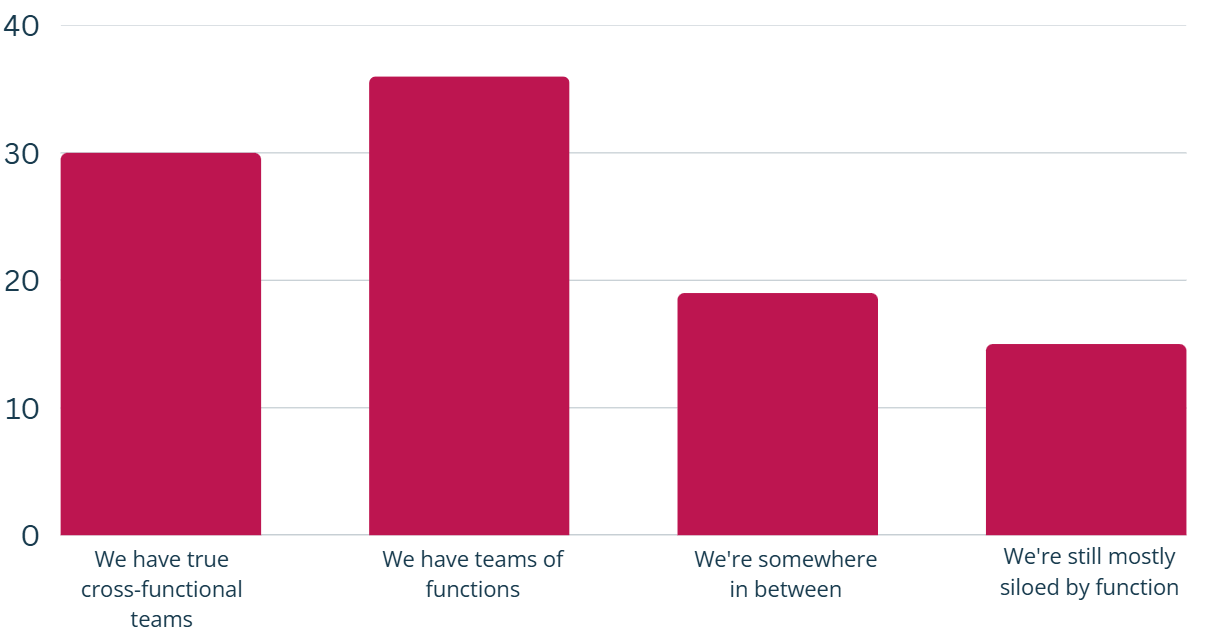
Last week’s poll asked which team structure best describes how people are working today, and the results suggest that true cross-functional teams are still not the norm. While 30% say they have real cross-functional teams with shared goals, blurred roles, and team-owned processes, the biggest group (36%) still describes their setup as teams of functions: mixed disciplines on paper, but with separate reporting lines and ways of working. Another 19% sit somewhere in between, while 15% remain mostly siloed by function.
That split matters because structure shapes behaviour. A team of functions can look collaborative from the outside, but if incentives, processes, and decision-making still live inside functional boundaries, you tend to get handoffs instead of shared ownership. True cross-functional teams are different: they are organised around outcomes, not disciplines, and that changes how quickly they learn, decide, and adapt.
My read is that many organisations are in transition, but haven’t finished the move. They’ve assembled the right people, but not yet redesigned the system around them. Until goals, reporting lines, and operating rhythms all support shared ownership, most teams will stay in that halfway state where collaboration sounds right but still feels harder than it should.
If you want to go into how careers and leadership are shifting as AI compresses the ladder, my ebook Managing Your Career In The Age Of AI explores how to build judgment, relationships, and influence in a world that keeps trying to automate the surface of the work.