- The Product Model
- Posts
- The Product Model #288 - How To Create A Compelling Product Vision
The Product Model #288 - How To Create A Compelling Product Vision
This Week’s Updates: Distributed Leadership, Safer AI Products, Smarter Research Tools, Compressed Design Process, Foundations For AI-Accelerated Change and more...

Rory Madden
April 14, 2026

How To Create A Compelling Product Vision
The most effective visions paint vivid pictures of customer transformation through a systematic four-step approach:
Develop rich personas that go beyond demographics
Identify their jobs to be done across functional, emotional, and social dimensions
Envision transformational rather than incremental improvements
Craft a customer-centric narrative
The first three steps help you to identify the content, whereas the fourth step is how you communicate it. Successful product visions don't just describe features; they illuminate better lives made possible for real people.
Structuring the story as a hero's journey where your customer overcomes challenges to reach success helps you to keep the focus where it needs to be. The best visions make people believe that transformation isn't just possible but inevitable, turning customers into believers who help build the future you're selling.
What's the biggest challenge when creating product visions? |
This Week’s Updates
Enabling the Team
Distributed Leadership: When Everyone's A Captain by Joost Minnaar
Flat organisations still need leadership, but it needs to be shared across the team rather than concentrated in formal managers. Clear principles, direct communication, and strong peer sponsorship help people take ownership without losing accountability.
Why Great Innovations Fail To Scale by Linda A. Hill, Emily Tedards and Jason Wild
Strong ideas do not scale on their own. Innovation works better when leaders can connect teams, share ownership across boundaries, and keep partnerships working long enough to turn promising concepts into repeatable results.
Product Direction
How To Create A Compelling Product Vision: A Step-By-Step Guide by Rory Madden
A powerful product vision serves as the North Star for your entire development team, but too often, product visions are abstract statements that sound impressive yet fail to inspire action. In this article, I'll share how you can create an inspiring vision that drives action.
Use These Practices To Build Safer AI Products | Dscout (Sponsored Content) by Meredith McDermott, Marysia Winkels, Elizabeth Allen
Launching new AI products comes with risk. These protocols and approaches will help you build a safer product for users and your company.
Continuous Research
Tell Me Where It Hurts: Moderating Real Users In UX Research by Ticiana Paura
Good research depends on hearing where users struggle in real situations, not ideal ones. Create enough trust and space for people to show confusion, hesitation, and workarounds, then use that evidence to ground decisions in real behaviour rather than assumptions.
Your Research Tools Got Smarter… Did You? by Josh LaMar
As AI automates more of the collection and analysis work, researchers create more value when they connect evidence to business decisions. Use AI for speed and scale, then focus human effort on synthesis, stakeholder trust, and judging where automation helps or harms the user experience.
Continuous Design
Designing AI Experiences People Actually Use by Buzz Usborne
AI features work better when they reduce ambiguity, show value early, and let users shape or verify the output before more autonomy is introduced. Use structured starting points, human-in-the-loop flows, and lower-risk interactions to build trust without increasing effort.
Design Process Isn't Dead, It’s Compressed by Sarah Gibbons and Huei-Hsin Wang
As AI speeds up design work, the argument to "throw out the process" misrepresents how experienced designers work.
Continuous Development
One List To Rule Them All by James Stanier
Teams make better progress when leaders turn competing initiatives into one clear, ordered list. A single ranking makes trade-offs visible, reduces resource spreading, and helps teams focus effort on the work that matters most.
Building Foundations For Continuous (AI-Accelerated) Change by Susanne Kaiser
AI speeds up delivery only when the system around it can absorb the extra output. Reduce handoffs, clarify ownership, improve architecture, and focus teams on flow so AI acceleration increases throughput instead of creating more queues, rework, and instability.
Seen an interesting article online? Share it with us, and we might feature it in our next issue!
Click here to share an article

Price Increase Alert!
Only A Few Weeks To Go, Only A Few Tickets Left

There are now only a few weeks left until UXDX EMEA and UXDX USA 2026, and the next ticket price increase is this weekend on 19/4. If you already know Berlin or New York is on your radar, this is the moment to get your ticket(s) before the rate moves up.
With the full agenda live, you do not need to buy on hope. You can see the speakers, the sessions, and the themes shaping this year’s events, then decide while the current pricing is still available. If you are planning to join, it makes sense to do it now rather than pay more a few days from now. Go to the ticket page by clicking on one of the events below:
UXDX USA 10% Discount: 10NEWSLETTERUSA26 | UXDX EMEA 10% Discount: 10NEWSLETTEREMEA26 |


FREE COMMUNITY EVENTS
IN-PERSON Tomorrow: Oslo Tomorrow: Lisbon 16 Apr: Boise 17 Apr: Edinburgh 21 Apr: Barcelona 22 Apr: Berlin 26 Apr: Houston 27 Apr: Hamburg 29 Apr: London 🔔 Want a UXDX Community event in your city? or, alternatively, if your company wants to host an in-person event, please reply and let us know. | ONLINE |
UXDX 2026 Speaker Announcements

Something is shifting inside product teams. AI is not just speeding up delivery. It is changing how ideas are shaped, how decisions get made, and how product, design, and engineering work together from the start. These sessions at UXDX EMEA 2026 in Berlin and UXDX USA 2026 in New York show why.
At UXDX EMEA 2026 in Berlin, John Vetan (Design Sprint Academy) will focus on one of the biggest problems teams face right now: how to turn AI enthusiasm into something clear, useful, and worth building. His session is designed to help teams move past vague ambition and get better at identifying the problems AI can genuinely solve.
Also in Berlin, Michael McKay (Mckay Consulting - Five Mindsets) will explore how storytelling, video, and synthetic personas can help teams shape stronger product value propositions. As more teams move faster with AI, the ability to align around the right story and the right customer need becomes even more important.
At UXDX USA 2026 in New York, Keyvan Azami (Google) and David Kossnick (Figma) will take on one of the biggest changes happening in modern product development: the collapse of the old handoff model. What used to be a sequence of product, design, then engineering is becoming a more continuous, AI-assisted loop. Their conversation will look at what that means for team structure, decision-making, and the way ideas move from concept to shipped product.
Cristina Fuser (BuzzFeed) will bring the organisational view, looking at what happens when board-level AI pressure meets the reality of fragmented experiments, tired teams, and legacy systems. Drawing on BuzzFeed’s work across news, entertainment, and subscriptions, she will show how to turn pressure into practical value across teams and products.
And Christina Kalsow-Ramos (Work & Co) will lead an interactive workshop on how teams can collaborate better when AI is part of the workflow. With real examples and a grounded approach, she will explore how product managers, designers, and engineers can align earlier, apply better judgement, and avoid the common mistakes that slow good teams down.
Book your ticket for Berlin or New York and be part of the conversations shaping how modern product teams actually work.
Missed the announcements of other speakers? You can find the highlights of the speakers announced in March here.
Video Of The Week
Framework for Balancing Short-Term Wins With
Long-Term Product Goals
Strategy is the easy part; execution is the test. In her talk, Michelle Parsons shares a portfolio framework that helps product teams turn strategy into measurable outcomes without losing the thread when reality hits. Instead of treating the roadmap like a single queue, she balances three types of work:
Quick hits to test hypotheses fast
Small bets to improve what you shipped and protect trust
Big bets that drive step-change results once de-risked.
The Netflix Kids case study brings it to life. The team wanted a bold “favourites-first” kids experience, but it was too risky to build without proof. So they ran a quick hit where kids already were: search. By replacing “popular searches” with “watch again” for kids' profiles and making play easier, they drove a 15% lift in watch time. That result earned credibility, unlocked the larger investment, and shifted the conversation from debate to learning. Check out the full talk here:
The Results of Last Week’s Poll
The question: Which SpaceX narrative technique would be hardest to replicate for other products?
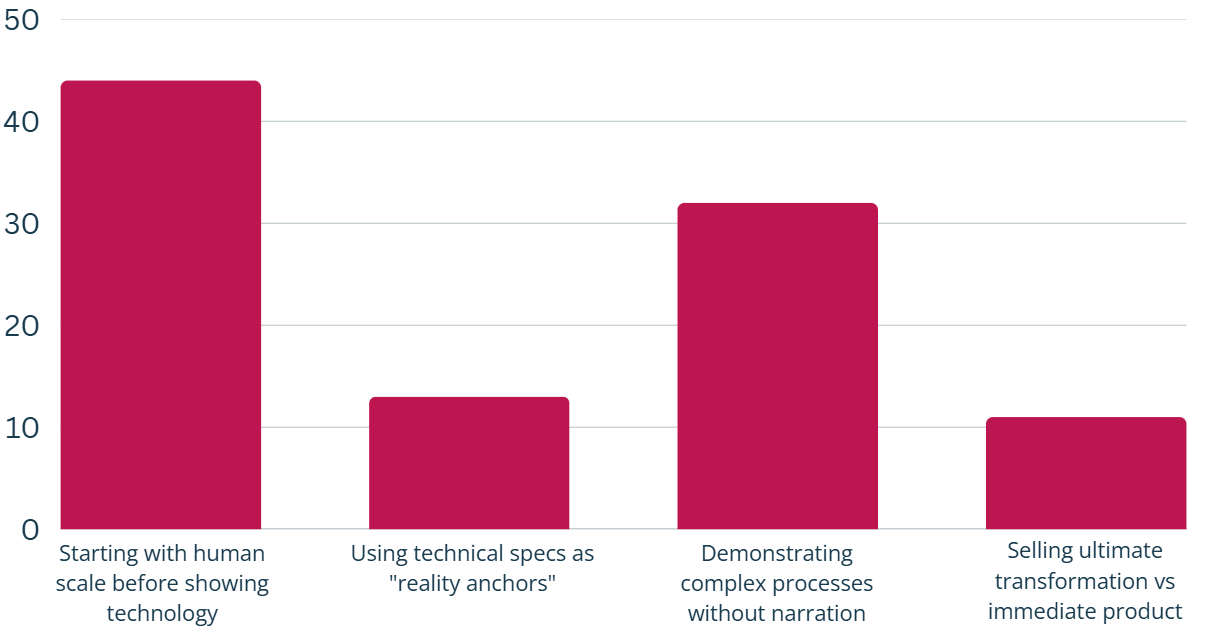
Last week’s poll asked which SpaceX narrative technique would be hardest to replicate, and one answer clearly stood out. Nearly half (44%) pointed to starting with a human scale before showing the technology. That is interesting, because on the surface it looks simple, but in practice it requires real confidence in your product. You have to believe the value is strong enough to land before you explain how it works.
The next biggest challenge (32%) was demonstrating complex processes without narration. That is a different kind of difficulty. It is not about confidence, but clarity. If your product, system, or journey cannot be understood visually or through interaction alone, it often means the experience itself is still too complicated. The smaller responses are still telling. Only 13% chose using technical specs as “reality anchors,” and 11% picked selling the ultimate transformation. My read is that most teams are comfortable talking about features and future vision. The harder part is bridging the gap between the two in a way that feels immediate, intuitive, and grounded in real user value.
That is what makes the top two answers so hard to replicate. They both force teams to simplify. Either you make the value obvious at a human level, or you make the system understandable without explanation. Most products struggle with both, which is why they fall back on specs, slides, and storytelling that explains rather than shows.
Want to go into how careers and leadership are shifting as AI compresses the ladder? My ebook Managing Your Career In The Age Of AI explores how to build judgment, relationships, and influence in a world that keeps trying to automate the surface of the work.