- The Product Model
- Posts
- The Product Model #290 - Single Threaded Leaders: Breaking Through the KPI Prison
The Product Model #290 - Single Threaded Leaders: Breaking Through the KPI Prison
This Week’s Updates: Something Big Is Happening, Guessing Direction, Agentic Research Systems, GenUI vs Vibe Coding, Decentralised Delivery and more...

Rory Madden
April 28, 2026

Single-Threaded Leaders: Breaking Through the KPI Prison
When companies launch transformational initiatives, they typically assign them to existing leaders who are already measured on current business KPIs. This creates an inevitable conflict: leaders will always prioritize the metrics they're evaluated on over new strategic projects.
As Amazon discovered, "culture eats strategy for breakfast, but KPIs drive culture." so they created the concept of a Single Threaded Leader: executives who are "100% dedicated and accountable to a specific product".
Amazon's Digital Media division succeeded because it operated independently with its own two-pizza teams, dedicated resources, and CEO-level attention.
I go into more detail about when you need , and when you don't need, a single threaded leader in my article below.
If you were asked to lead a smaller team for a high-potential new initiative, how would you feel? |
This Week’s Updates
Enabling the Team
Single-Threaded Leaders: Breaking Through The KPI Prison by Rory Madden
Many new strategic initiatives fail because of the misalignment between how companies structure accountability and how they allocate attention. If you want a new initiative to succeed, it can't be some executives part time job.
Something Big Is Happening by Matt Shumer
AI is moving from assistant to operator, which means the bigger challenge for teams is no longer whether to use it, but how quickly roles, expectations, and workflows will need to change around it. Leaders who ignore the pace of change risk leaving their teams unprepared for a much more automated version of knowledge work.
Product Direction
Basic Links by John Cutler
Shipping does not deliver outcomes on its own. Teams need to make the links between actions, early signals, and longer-term results explicit so they can choose better bets, test assumptions earlier, and learn whether their strategy is actually working.
In Praise Of Guessing by Christina Wodtke
Teams make better goals and estimates when they treat early numbers as informed guesses instead of pretending they are certain. Creating space to predict, measure, and learn helps teams build stronger judgment over time without encouraging sandbagging or decision paralysis.
Continuous Research
The End Of The Passive Researcher: Trading Academic Rigor For Radical Agility | Sponsored Content by Claire Bonneau (Dovetail)
Research has more impact when it shapes decisions as teams build, rather than arriving as a polished report after the fact. Sharing smaller insights earlier, working ahead of the roadmap, and staying close to product teams helps reduce the risk of building the wrong thing.
Calibration Matters More Than Automation: What AI’s History Suggests About Building Agentic Research Systems by George Jensen
I adds more value in research when teams use it to challenge, calibrate, and strengthen analysis rather than treat it as an oracle. Build governed workflows, test outputs against clear qualitative standards, and use human review to catch drift, bias, and weak reasoning before insights shape decisions.
Continuous Design
GenUI vs. Vibe Coding: Who’s Designing? by Kate Moran
Generative UI and vibe coding both produce AI-generated interfaces, but they differ in a critical way: who decides to build. Learn how this distinction shapes design accountability, failure modes, and who actually benefits.
Houston, We Have A Problem: Building Trust In The Age Of AI | Sponsored Content by Kim Miller (Knapsack)
AI is easier to trust when it is grounded in a strong design system rather than generating from scattered files and inconsistent standards. Clear guardrails, shared patterns, and a reliable source of truth help teams create more consistent outputs and make AI support design quality instead of weakening it.
Continuous Development
So You Want To Hire A Forward Deployed Engineer by First Round
Forward deployed engineers work best when companies need technical people close to customers to shorten feedback loops, uncover product opportunities, and help land complex enterprise deals. The model creates value when teams give FDEs real engineering scope, clear success measures, and the freedom to solve recurring customer problems rather than just run implementations.
Towards A Decentralised Delivery Of Infrastructure: A Data Platform Journey by Jose Moreno
Infrastructure teams move faster when application teams can provision what they need through shared patterns, clear guardrails, and automated delivery instead of waiting on a central backlog. Strong platform standards, role clarity, and reusable tooling make self-service possible without creating drift or weakening governance.
Seen an interesting article online? Share it with us, and we might feature it in our next issue!
Click here to share an article

VOTE NOW!
Who Should Win The UXDX EMEA 2026 Awards?

Vote now on LinkedIn: Unblocker Award | Best Use of AI Award | Impact Award
The public vote is now open for the UXDX Awards and counts for 25% of the final score. Across the Unblocker, Impact, and Best Use of AI categories, this year’s finalists show what strong product teams can achieve when they remove blockers, connect evidence to outcomes, and use AI to change how work gets done.
Read the finalist case studies, then vote for the team you think should win in each category. The winners will be announced live on stage at UXDX EMEA 2026 in Berlin.
Dive in deeper before voting by checking out the details for each case study on our website here: Unblocker Award | Best Use of AI Award | Impact Award
UXDX USA 10% Discount: 10NEWSLETTERUSA26 | UXDX EMEA 10% Discount: 10NEWSLETTEREMEA26 |


FREE COMMUNITY EVENTS
IN-PERSON 29 Apr: London 29 Apr: Copenhagen 29 Apr: Cleveland 7 May: Sydney 21 May: Edinburgh 28 May: Seattle 🔔 Want a UXDX Community event in your city? or, alternatively, if your company wants to host an in-person event, please reply and let us know. | ONLINE |
UXDX 2026 Speaker Announcements
AI is already reshaping how products are built, which means the real challenge is no longer speed alone, but judgment, trust, and how teams adapt. Here’s what you can look forward to at UXDX 2026:
In Berlin, Alex Radu (JPMorgan Chase), Pamela Mead (SumUp) and Aastha Yadav (Bolt) will explore what actually changes when AI becomes embedded in the way teams work. As execution gets easier, they’ll look at why depth, understanding, and better decision-making become the real advantage.
Also in Berlin, Sam Bradley (PayPal) and Pallavi Modi (zooplus) will debate one of the biggest challenges in personalisation today: where it genuinely helps people and where it starts to feel intrusive. Expect a practical discussion on trust, context, restraint, and what responsible personalisation looks like when money and identity are involved.
In New York, Kent Eisenhuth (Waymo) will share how thoughtful UX can make AI experiences more intuitive and human. Drawing on work integrating visual data into a chatbot environment, his session offers practical lessons for teams building AI products people can actually understand and use.
Also in New York, Donnie D'Amato (Design Systems House) and Alex Wilson (T. Rowe Price) will discuss what design systems become when AI starts generating more of the interface layer. Their session will explore the next generation of design systems as rules, constraints, and infrastructure for dynamic experiences.
Missed the announcements of other speakers? You can find the highlights of the speakers announced in March here.
Video Of The Week
The Real Impact Of Mergers & Acquisitions On Your Product Team
Seven acquisitions. One major merger. And the product team is still expected to ship, keep customers happy, and somehow feel “aligned.” In this talk, Tasha Melchior (VP of Product at Everway) shares what M&A really does to the holy trinity of people, product, and process. The board game version is fun. The real version feels like the rules changed mid-play.
Tasha breaks down why every acquisition tips the scale and pushes teams into storming, how overlapping product portfolios turn into painful consolidation decisions, and what happens when a process that works gets replaced overnight because leadership changes. Her most useful takeaway is not a framework slide. It is a reality check: M&A requires emotional agility as much as agile delivery. Feeling off balance does not mean you are failing. It means the family just changed, and you are doing the work of becoming one team. Watch the full talk now:
The Results of Last Week’s Poll
The question: What's the biggest challenge your team faces when making product decisions?
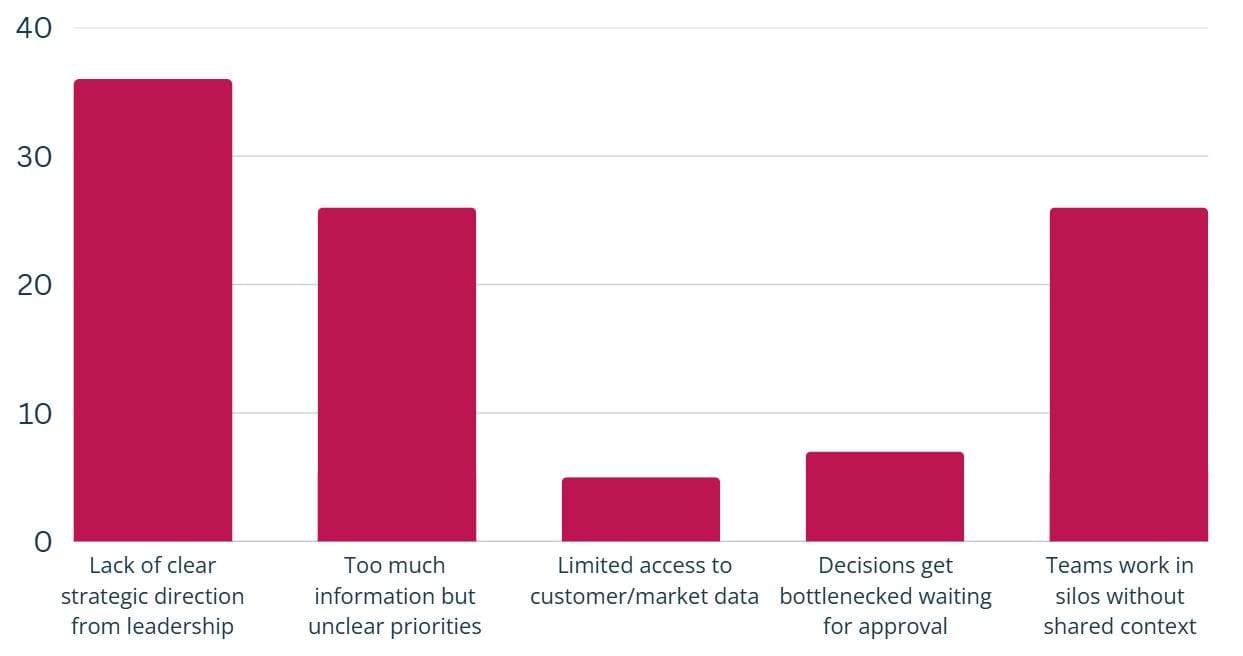
Last week’s poll asked what the biggest challenge is when teams make product decisions, and the results point to a clear theme: decision-making breaks down when teams do not have a strong enough shared direction. The top response was lack of clear strategic direction from leadership (36%). That feels significant because product teams can often handle complexity, ambiguity and trade-offs, but only if they understand what they are optimising for. Without that strategic clarity, every decision becomes harder than it needs to be.
Two answers tied at 26%: too much information but unclear priorities, and teams working in silos without shared context. Those two are closely connected. More data does not automatically lead to better decisions if teams are missing a shared framework for what matters most. And when teams are working from different contexts, they are more likely to interpret the same information in different ways. Only 7% said decisions get bottlenecked waiting for approval, and just 5% pointed to limited access to customer or market data. The main issue is not simply governance or a lack of inputs. In many cases, teams are not waiting because they cannot decide; they are struggling because the criteria for making the decision are not clear enough.
The takeaway is that better product decisions do not come from more meetings, more data or more approvals. They come from clearer strategy, shared context and stronger prioritisation. Without those foundations, even well-informed teams can end up moving slowly, second-guessing themselves or making decisions that do not connect back to the bigger business direction.
Want to go into how careers and leadership are shifting as AI compresses the ladder? My ebook Managing Your Career In The Age Of AI explores how to build judgment, relationships, and influence in a world that keeps trying to automate the surface of the work.